

 Suzuki Marine
 Suzuki Motorcycles
the history of the suzuki jimny

For more than 50 years this little Suzuki has stuck to one simple idea: to be a tough, honest, go-anywhere 4×4 that is cost-effective. From the 1970 LJ10 through to today’s Jimny Rhino, that idea has barely shifted, and that consistency is exactly why it’s earned such a loyal following in Australia and around the world.
How it all began (1968-1970)
Back in the late 1960s, Suzuki was known for small cars and motorbikes, not off-road vehicles. That changed when the company picked up the rights to a lightweight 4×4 built by a small manufacturer called Hope Motor Company, then set about turning it into something it could build at scale. The brief was refreshingly simple: keep it light, keep it simple, and make sure it could get places that traditional 4x4s couldn’t.
Suzuki also wanted it to qualify as a Japanese “Kei” car, a category with strict limits on engine size and exterior dimensions. That meant giving up a few luxuries, including a proper fourth seat, in exchange for low running costs and easy parking. Toughness paired with accessibility became the Jimny’s founding philosophy, one that’s never changed.
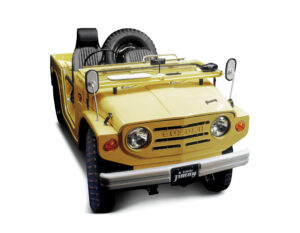
First Generation – LJ10 (1970-1981)
The Jimny LJ10 landed in April 1970, powered by a tiny 359cc two-stroke engine, a four-speed manual and a two-speed transfer case for part-time four-wheel drive. Built on a body-on-frame chassis with leaf-spring suspension and a soft canvas top, it was basic by design, and that simplicity was a big part of the appeal.
Suzuki kept refining the formula from there. The water-cooled LJ20 arrived in 1972, followed by the export-focused LJ50 in the mid-1970s, which bumped the engine out to 539cc for markets like Australia. Then came the LJ80 in 1977-78, with a bigger 797cc four-stroke engine that finally gave it capability for both on and off road. The LJ80 sold well in Australia and other early right-hand-drive markets, and it’s really where the Jimny’s popularity here started to take hold.
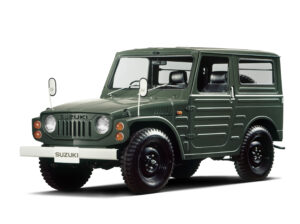
Second Generation – SJ410/SJ413 (1981-1998)
The SJ generation, launched in 1981, was the Jimny’s first proper step onto the world stage. A new chassis sharpened up the on-road manners, while a bigger four-cylinder engine, eventually growing to 1.3 litres in the SJ413, gave it the grunt to keep pace with larger 4x4s.
This is also where the Jimny picked up its long list of export aliases: Samurai in the United States, Sierra in some right-hand-drive markets, and here in Australia, the badge-engineered Holden Drover, sold through Holden dealerships from the mid-1980s. Gentle updates kept it in production for close to 17 years, cementing the Jimny as a genuine, affordable alternative to those bigger off-roaders.
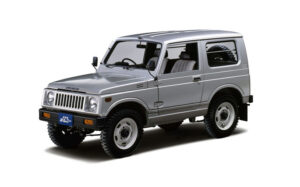
Third Generation – JB series (1998-2018)
Unveiled at the 1997 Tokyo Motor Show and launched in 1998, the JB-series Jimny brought a rounder, more modern look while holding onto the ladder-frame chassis and low-range gearing the nameplate had built its name on. Sold globally under codes like JB23, JB43 and JB53 depending on the market and engine, it stuck around for two decades, an unusually long run that gave the Jimny plenty of time to build a devoted following.
It was during this era that the Jimny really became a favourite of the custom off-road crowd. Its light weight, simple mechanicals and strong aftermarket options made it a blank canvas for modification, with bull bars, lift kits, roof racks and chunky tyres becoming almost standard among fans. That modification culture has done more to build the Jimny’s cult status than any marketing ever could.
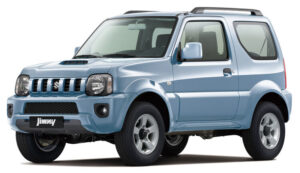
Fourth Generation – JB64/JB74 (2018-present)
The current Jimny, launched in July 2018 as the JB64 for Japan’s kei-car market and the wider JB74 Sierra for export markets including Australia, took the retro-boxy styling cues of the original LJ10 and wrapped them around a thoroughly modern platform. The result struck a nerve with buyers everywhere. Demand far outweighed supply, and long waitlists became the norm in almost every market the Jimny landed in, Australia very much included.
It remains in production today, and in 2023 the range grew further with the arrival of a 5-door Jimny XL body style, widening the Jimny’s appeal beyond die-hard off-roaders to buyers after a bit more everyday practicality without giving up its trademark capability.
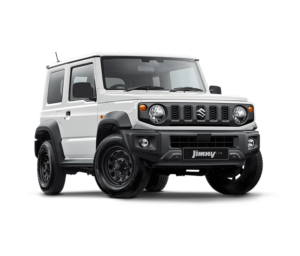
Why is the Jimny so popular with 4×4 fans worldwide?
Part of it comes down to genuine capability. The Jimny’s ladder-frame chassis, low-range transfer case and short wheelbase give it off-road ability that punches well above its small size and price tag. But just as important is the modification culture that took hold during the JB era and is still going strong today: a huge global aftermarket, active enthusiast communities, and a design simple enough that owners can personalise their Jimny without specialist tools or a big budget. Throw in five decades of consistent brand identity, and it’s not hard to see why the Jimny inspires the kind of loyalty most manufacturers can only dream about.
The newest Jimny in Australia – meet the Jimny Rhino
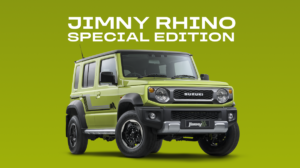
The latest addition to the local range is the Jimny Rhino Special Edition, built on the practical 5-door Jimny XL. It’s finished in signature Kinetic Yellow paint with a Pearl Black roof, and wears a bespoke decal pack featuring a charging rhino motif and the Japanese katakana for “rhino” running across the rear wheel arch. Exterior upgrades include a heritage-inspired front grille, chrome trim, front and rear mudflaps, and unique 15-inch diamond-cut alloy wheels with a Shuriken-inspired design.
Inside, the Rhino gets black leather-wrapped door handles and passenger grab handle with kinetic yellow stitching and laser-etched Rhino logos, 8-colour customisable footwell lighting, upgraded Pioneer front speakers and a bespoke interior badge. Every Jimny Rhino Special Edition also comes with an exclusive Rhino Go Pack, a bundle of branded adventure gear designed to get owners out exploring from day one.
FAQs
Are Suzuki Jimnys reliable?
The Jimny has built a solid reputation for mechanical simplicity and durability over five decades, thanks to its basic body-on-frame construction and straightforward drivetrain. Those traits tend to make it easier and cheaper to maintain and repair than more complex SUVs. That reputation comes from decades of owner testimonials and the model’s long production run rather than statistics, so it’s still worth doing your own research on the specific generation and model year you’re eyeing off.
When was the Suzuki Jimny launched?
The original Jimny (LJ10) launched in April 1970. The current, fourth-generation model arrived in July 2018 as the JB64 and JB74, and the 5-door Jimny XL, the basis for the Jimny Rhino Special Edition, joined the range in 2023.
When is the new Suzuki Jimny coming out?
The fourth-generation Jimny remains in production and on sale in Australia today, with the newest variant being the Jimny Rhino Special Edition. Keep an eye on the Suzuki Jimny range page for the latest updates on new models and special editions.
Are Suzuki Jimnys safe?
The current Jimny carries a 3-star ANCAP safety rating, reflecting lower scores in structural performance, pedestrian protection and driver assist technology compared to larger, more modern SUVs. It does come standard with dual frontal, side chest-protecting and side curtain airbags, along with autonomous emergency braking and lane departure warning. If you’re cross-shopping the Jimny against larger SUVs, it’s worth weighing up its off-road capability and simplicity against that lower crash-test score.
Explore the Jimny range
From the 1970 LJ10 to today’s Jimny Rhino Special Edition, the Jimny has never lost sight of what made it special in the first place. Ready to see what five decades of go-anywhere engineering feels like from the driver’s seat? Explore the Suzuki Jimny range or book a test drive at your nearest dealer today.