




 Suzuki Marine
 Suzuki Motorcycles

Comparing Electric and Hybrid Cars vs Petrol Cars
Choosing a car used to be simple. Petrol. Check. Now there are hybrids, plug-in hybrids, and full EVs and somehow, you’re expected to know everything about them. But don’t worry, here’s everything you need to know.
What is the difference between electric, hybrid and petrol cars?
Petrol cars run on a traditional combustion engine. Widely available, lower purchase price, and deeply committed to reminding you when fuel costs go up.
Hybrid cars utilise a petrol engine with an electric motor that charges through regenerative braking. Every time you slow down, it quietly turns your frustration into electricity. No plugging in required.
Plug-in hybrids (PHEVs) go further with a larger battery that lets you cover short distances on electric power alone – great for city driving, and mildly smug at traffic lights.
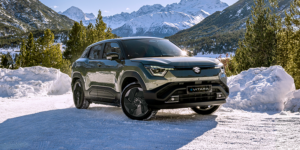
Electric cars run entirely on battery power – zero emissions, whisper-quiet, and a running cost per 100km that will make you deeply regret every petrol receipt. The Suzuki e VITARA, arriving July 2026, offers up to 395km of range and starts from $46,990 driveaway, making the switch more practical than ever.
Electric vs hybrid vs petrol: pros and cons
Petrol Cars
Pros:
Lower purchase price, no charging needed, serviced everywhere, great for long distances.
Cons:
Higher fuel costs long-term, high emissions that can be hard to digest, and a complicated relationship with the bowser, especially nowadays.
Hybrid Cars
Pros:
Better fuel efficiency in stop-start city traffic, no plug-in required, lower emissions than petrol. The sensible middle child of the powertrain family.
Cons:
Still needs petrol, moderate savings versus going full electric, fewer government incentives than a pure EV.
Electric Cars
Pros:
Very low cost per 100km, zero emissions, access to federal FBT exemptions and state rebates, and maintenance so simple, you could do it yourself. No oil changes. Ever. The e VITARA backs this up with an 8-year battery warranty and a 5-year capped-price service program.
Cons:
With higher upfront cost, charging takes longer than a petrol fill (though overnight home charging solves most of this), and remote outback drives need more planning.
Comparing costs
Based on publicly available Australian pricing, government incentive guidelines, and current fuel and electricity rates. Your numbers will vary.
|
Factor |
Petrol |
Hybrid |
Electric |
|
Purchase price |
$18,000–$50,000+ |
$25,000–$55,000+ |
$45,000–$100,000+ |
|
Cost per 100 km |
~$14–$18 (at 95 RON) |
~$8–$12 (combined) |
~$3–$5 (home charging) |
|
Maintenance |
Higher servicing costs; more mechanical components |
Moderate; fewer brake replacements due to regenerative braking |
Lower; no oil changes, fewer moving parts |
|
Government incentives |
None |
Some state rebates may apply |
Federal FBT exemption; state rebates up to $3,000+ (varies) |
|
Estimated 5-year cost |
Higher overall; fuel costs add up |
Mid-range; fuel savings offset higher purchase price |
Competitive; lower running costs offset higher sticker price |
Sources: Electric Vehicle Council of Australia, Australian Government Clean Energy Finance Corporation, state government EV rebate schemes (VIC, NSW, QLD, SA).
How to choose between electric, hybrid and petrol cars
Here are six things worth thinking about before you decide.
Step 1: Understand your driving habits
Hybrids shine in city stop-start traffic. EVs suit regular commutes with predictable distances. If you frequently drive long regional routes, petrol or hybrid still gives you the flexibility you’ll appreciate.
Step 2: Assess charging access
Can you charge it at home? Is there a public charger nearby? Australia’s network is growing steadily, but regional coverage varies. The e VITARA, for example, supports DC fast charging from 10 to 80 per cent in 45 minutes, or a full overnight top-up via an 11kW home charger. Worth thinking about before you commit.
Step 3: Compare total costs
The sticker price is just the start. Factor in fuel or electricity, servicing, insurance, and any rebates you qualify for. EV’s lower running costs often make the higher upfront price look very reasonable over five years.
Step 4: Compare performance
EVs deliver instant torque – the kind that makes passengers grip the door handle. The e VITARA Motion puts out 193Nm from a standstill, while the dual-motor Ultra hits 307Nm with AWD. Hybrids blend electric smoothness with a petrol range. Petrol is a seasoned veteran. Numbers matter, but so does how a car actually feels on the road.
Step 5: Test drive each option
Reading about cars is one thing but driving them is another. Suzuki dealers offer test drives across the full range – from self-charging hybrids through to the e VITARA once it arrives.
Step 6: Consider future trends
EV adoption is accelerating across Australia, infrastructure is expanding, and even traditionally petrol-focused brands are making the shift – Suzuki’s first EV, the e VITARA, is proof of that, arriving here in July 2026. A hybrid is a smart bridge. An EV puts you ahead of the curve. Either way, the direction of travel is clear.
No matter your lifestyle, there’s a perfect Suzuki match for you
Suzuki has fuel-efficient everyday cars, self-charging hybrids, and now with the e VITARA arriving in July 2026, a fully electric SUV built for Australian roads. Whatever you’re after, we’ve probably got something for you.
Explore our range of vehicles
Explore our range of hybrid cars
Explore our electric car offering